Sunday, 3 April 2011

File host sharecash

File hosting Sharecash is one of the high paying file hostings in the Internet. Sharecash offers about $200-$600 per 1000 downloads. As for me, such rates are quite amazing. And it could be a big lost not to try to earn on Sharecash.
Interesting project - file host Sharecash. How to earn on file hosting
Well, let see what Sharecash offers for their members:
- Sharecash gives highest download rates around the world. Sharecash pays from 20 to 60 cents per download or from $200 to $600 per 1000 downloads!
- Sharecash has the affiliate or referral system. You can earn 10% of what each user, which was refered by you, earns! Besides this, you can now talk to and train your affiliatearmy to make you even more cash on Sharecash.
- You earn 75% from Premium Memberships. Downloaders can buy a premium membership on Sharecash.
- Sharecash has low cashout limit or, in other words, minimum payout. You can get your money after earning only $10. In your user panel on Sharecash you will see each day’s earnings. On the 1st of each month each users earnings are reviewed by Sharecash team and approved. After the earnings are approved by Sharecash on the 1st of each month, you are able to request a payout. All payouts from Sharecash begin to go out on the 15th of the next month, and continue to go out for one week. So, for example, you get paid the money you earned on Sharecash from January 1st to January 31st on February 15th.
- You currently have five options for payouts from Sharecash: Paypal, ePassporte, Check, Western Union or a Wire Transfer. Checks are for US residents only, and you can only request payment via Western Union or Wire Transfer if you are requesting more than 100$.
- Sharecash doesn’t have limitations on file type.
- Sharecash pays for international downloads. You get paid by Sharecash for any country!
- On Sharecash there are friendly, 24/7 online community on Forum, Live Chat, TeamSpeak and Ventrillo.
- Sharecash really pays for every download. There are no “scrubbing” on Sharecash. Nearly every other high paying download sites will “scrub” off perfectly good downloads, or not count them. Sharecash is not from them.
- On Sharecash you can use high-tech FTP, direct, and Remote uploader for uploading of your files on Sharecash!
- Sharecash is constantly adding new features.
Never before has making money been so easy – or payouts so high. Try to earn with Sharecash!
Register on Sharecash now!

The Nature of Children's Play

In play, children expand their understanding of themselves and others, their knowledge of the physical world, and their ability to communicate with peers and adults. This digest discusses children's play and its relationship to developmental growth from infancy to middle childhood. The digest also suggests ways in which educators and other adults can support children's play

Sensorimotor Play

In what Piaget (1962) aptly described as sensorimotor practice play, infants and toddlers experiment with bodily sensation and motor movements, and with objects and people. By 6 months of age, infants have developed simple but consistent action schemes through trial and error and much practice. Infants use action schemes, such as pushing and grasping, to make interesting things happen. An infant will push a ball and make it roll in order to experience the sensation and pleasure of movement.
As children master new motor abilities, simple schemes are coordinated to create more complex play sequences. Older infants will push a ball, crawl after it, and retrieve it. When infants of 9 months are given an array of objects, they apply the same limited actions to all objects and see how they react. By pushing various objects, an infant learns that a ball rolls away, a bile spins, and a rattle makes noise. At about 12 months, objects bring forth more specific and differentiated actions. At this age, children will throw or kick a ball, but will shake rattles.
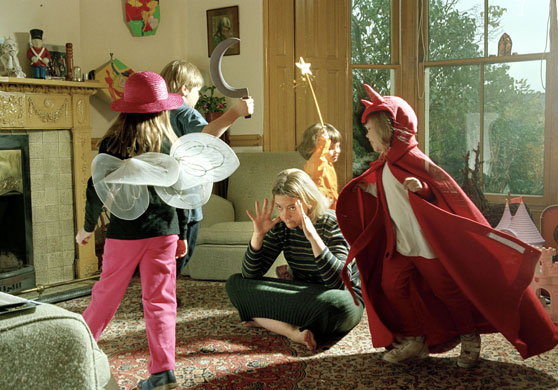
Gallery How to play : A woman sits bewildered as four children dance around herIn a toddler's second year, there is growing awareness of the functions of objects in the social world. The toddler puts a cup on a saucer and a spoon in her mouth. During the last half of this year, toddlers begin to represent their world symbolically as they transform and invent objects and roles. They may stir an imaginary drink and offer it to someone (Bergen, 1988). Adults initiate and support such play. They may push a baby on a swing or cheer its first awkward steps. Children's responses regulate the adult's actions. If the swing is pushed too high, a child's cries will guide the adult toward a gentler approach. In interactions with adults such as peekaboo, children learn to take turns, act with others, and engage others in play.

Pretend Play

As children develop the ability to represent experience symbolically, pretend play becomes a prominent activity. In this complex type of play, children carry out action plans, take on roles, and transform objects as they express their ideas and feelings about the social world (Garvey, 1984).
Action plans are blueprints for the ways in which actions and events are related and sequenced. Family-related themes in action plans are popular with young children, as are action plans for treating and healing and for averting threats.
Roles are identities children assume in play. Some roles are functional: necessary for a certain theme. For example, taking a trip requires passengers and a driver. Family roles such as mother, father and baby are popular, and are integrated into elaborate play with themes related to familiar home activities. Children also assume stereotyped character roles drawn from the larger culture, such as nurse, and fictional character roles drawn from books and television, such as He-Man. Play related to these roles tends to be more predictable and restricted than play related to direct experiences such as family life (Garvey, 1984).
As sociodramatic play emerges, objects begin to influence the roles children assume. For example, household implements trigger family-related roles and action plans, but capes stimulate superhero play. Perceptually bound younger children may be aided by the provision of realistic objects (Fein, 1981). Even three-year-olds can invent and transform objects to conform to plans.
By the age of four or five, children's ideas about the social world initiate most pretend play. While some pretend play is solitary or shared with adults, preschoolers' pretend or sociodramatic play is often shared with peers in the school or neighborhood. To implement and maintain pretend play episodes, a great deal of shared meaning must be negotiated among children. Play procedures may be talked about explicitly, or signaled subtly in role-appropriate action or dialogue. Players often make rule-like statements to guide behavior ("You have to finish your dinner, baby"). Potential conflicts are negotiated. Though meanings in play often reflect real world behavior, they also incorporate children's interpretations and wishes. The child in a role who orders a steak and piece of candy from a pretend menu is not directly copying anything he has seen before.
Construction play with symbolic themes is also popular with preschoolers, who use blocks and miniature cars and people to create model situations related to their experience. A kind of play with motion, rough and tumble play, is popular in preschool years. In this play, groups of children run, jump, and wrestle. Action patterns call for these behaviors to be performed at a high pitch. Adults may worry that such play will become aggressive, and they should probably monitor it. Children who participate in this play become skilled in their movements, distinguish between real and feigned aggression, and learn to regulate each other's activity (Garvey, 1984).

Games With Rules

Children become interested in formal games with peers by age five or younger. Older children's more logical and socialized ways of thinking make it possible for them to play games together. Games with rules are the most prominent form of play during middle childhood (Piaget, 1962).
The main organizing element in game play consists of explicit rules which guide children's group behavior. Game play is very organized in comparison to sociodramatic play. Games usually involve two or more sides, competition, and agreed-upon criteria for determining a winner. Children use games flexibly to meet social and intellectual needs. For example, choosing sides may affirm friendship and a pecking order. Games provide children with shared activities and goals. Children often negotiate rules in order to create the game they wish to play (King, 1986). They can learn reasoning strategies and skills from strategy games like checkers. In these games, children must consider at the same time both offensive alternatives and the need for defense. Many card games encourage awareness of mathematics and of the psychology of opponents. Such games can be intellectually motivating parts of pre- and primary school curriculum (Kamii & DeVries, 1980, Kamii, 1985).

The Adult Role In Children's Play

These general guidelines may be helpful:
  • Value children's play and talk to children about their play. Adults often say "I like the way you're working," but rarely, "I like the way you're playing."
  • Play with children when it is appropriate, especially during the early years. If adults pay attention to and engage in children's play, children get the message that play is valuable.
  • Create a playful atmosphere. It is important for adults to provide materials which children can explore and adapt in play.
  • When play appears to be stuck or unproductive, offer a new prop, suggest new roles, or provide new experiences, such as a field trip.
  • Intervene to ensure safe play. Even in older children's play, social conflicts often occur when children try to negotiate. Adults can help when children cannot solve these conflicts by themselves (Caldwell, 1977). Adults should identify play which has led to problems for particular children. They should check materials and equipment for safety. Finally, adults should make children aware of any hidden risks in physical challenges they set for themselves.

Saturday, 2 April 2011

A CELEBRATION OF AMERICA'S QUINTESSENTIAL DESSERT

If it has anything to do with the Ice Cream Sundae, it has everything to do with us.  We are dedicated to supporting and respecting the convivial traditions of the fountain and celebrating the pleasures of the Ice Cream Sundae in everyday life.


No dessert could be simpler than the Ice Cream Sundae – a scoop of ice cream, a sweet topping, and the ubiquitous whipped cream and cherry at the top. But icons are never really that simple, and, perhaps more than any other dish, the Sundae is an American icon.  Like people, nations are what they eat.  More than any other native dish, the Ice Cream Sundae is an essential reminder of the American genius for invention, passion for indulgence, and reputation for wackiness.  The French may have given refinement to ice cream with their coupes and parfaits, but it took American excess and ingenuity to create the Sundae.  It's as messy and irresistible as democracy itself.
strawberry ice cream sundae

Sundaes are us, and they have been pleasuring our collective senses ever since 1892, when an enterprising Ithaca, New York, soda fountain proprietor accessorized a scoop of ice cream with sweet syrup and candied cherry, then named it after the Sabbath. A sundae is not just any dish, but a dessert that is original, enduring, and authentically American.  For well over a century, the ice cream sundae has been a symbol of our abundance and appetite, our ingenuity, and our never-lost youth.  In their assembly, sundaes provide an unrestrained opportunity to express our essential character.  They acquire personality not only through their combination of ingredients, but through the history that they witness.  During the twists and turns our country has taken over the past hundred or so years, ice cream sundaes have been standing by to lift our spirits.  After the 1929 stock market crash, one of the few luxuries that average folks could afford was the democratically-priced sundae.  During World War II, patriotic "Victory Sundaes" included a Defense Saving Stamp with every purchase, while the Navy commissioned floating ice cream parlors - refrigerated barges with ice cream plants - to boost troop morale.  In wartime and in hard times, home refrigerators were stocked with ice creams that, with a dash of imagination, provided the basis for an irresistible sundae. 
Following the classic model, sundaes are served in footed, tulip-shaped glasses, filled with scoops of ice cream as the foundation for interplays of sauces or syrups, perhaps the crunch of nuts, and often a cloud of whipped cream and signature cherry.  Florence Fabricant of The New York Times called author Michael Turback's A Month of Sundaes (Red Rock Press, 2002) "an admiring portrait of a famous temptation-weaves together sundae history, regional styles, folklore and recipes."  Seven years and many sundaes later, Turback returns to his favorite topic and provides what has got to be the definitive listing of 100 versions of the classic dessert - from humble, forgotten relics to dishes that have become popular standards, arranged in alphabetical order and instantly accessible.  Ice Cream Sundae: 100 Greatest Fountain Formulas is more than just a collection of recipes.  On every page there is a scoop of history, a measure of technique, and a sprinkle of trivia, all in aid of explaining the unique Americaness of the sundae.

Team india won the worls cup 2011

MUMBAI (AFP) - Gautam Gambhir made 97 and skipper Mahendra Singh Dhoni smashed an unbeaten 91 off 79 balls as India won the World Cup for the first time since 1983 with a six-wicket victory over Sri Lanka on Saturday.
Sri Lanka, who won the toss and elected to bat in the day-night final, rode on Mahela Jayawardene’s 103 not out off 88 balls to pile up 274-6 in their 50 overs. India, cheered by a sell-out crowd of 33,000 at the Wankhede stadium, surpassed the challenging target with 10 balls to spare as Dhoni pounded Nuwan Kulasekara for the winning six. India had slumped to 31-2 by the sixth over when sling-arm fast bowler Lasith Malinga dismissed Virender Sehwag (0) second ball and had star batsman Sachin Tendulkar (18) caught behind in his fourth over.


“I took a quite few decisions tonight and if we hadn’t won I would have been asked quite a few questions,” said Dhoni, who batted at number five and had selected fast bowler Gambhir, who was dropped on 30 and escaped a run-out chance on 49, turned the match around by adding 83 for the third wicket with Virat Kohli and 109 for the fourth with Dhoni.
Yuvraj Singh, who was named the man of the tournament, partnered his skipper till the end with 21 not out after Gambhir was bowled by Thisara Perera in the 42nd over when 52 more were still needed.
Dhoni’s men emulated Kapil Dev’s compatriots who won the 1983 World Cup by beating the West Indies in the final at Lord’s in London. The victory, watched by Indian President Pratibha Patil and Sri Lanka’s head of state Mahinda Rajapakse, was the first occassion a team had won the tournament on home soil.
It was only the third time in 10 World Cup finals that a side batting second had chased down the victory target. The finale gave Tendulkar, the world’s most successful Test and one-day batsman, his first World Cup title in six appearances since 1992.

Why ocean is blue?


  • Blue wavelengths are absorbed the least by the deep ocean water and are scattered and reflected back to the observer’s eye
  • Particles in the water may help to reflect blue light
  • The ocean reflects the blue sky
Most of the time the ocean appears to be blue because this is the color our eyes see. But the ocean can be many other colors depending upon particles in the water, the depth of the water, and the amount of skylight.
The colors we see depend upon the reflection of the visible wavelengths of light to our eyes. The Franklin Institute provides a good explanation of how we see color at http://www.fi.edu/color/color.html.
Wavelengths of light pass through matter differently depending on the material’s composition. Blue wavelengths are transmitted to greater depths of the ocean, while red wavelengths are absorbed quickly. Water molecules scatter blue wavelengths by absorbing the light waves, and then rapidly reemitting the light waves in different directions. That is why there are mostly blue wavelengths that are reflected back to our eyes.
Sometimes oceans look green. This may be because there is an abundance of plant life or sediment from rivers that flow into the ocean. The blue light is absorbed more and the yellow pigments from plants mix with the blue light waves to produce the color green.
Sometimes parts of the oceans will look milky brown after a storm passes. This is because winds and currents associated with the storm churn up sand and sediment from the rivers that lead into the oceans.
The ocean may also reflect the blue sky. However this is prominent only at relatively low angles and when the water is smooth.

Friday, 1 April 2011

How to huy my girlfriend


Have you ever felt like giving a comforting hug to your girlfriend, but held back because you did not where and how to begin? Hugging forms one of the most common gestures of showing the other person that you care about him/her. So, whether you have hardly gone out for a few weeks with your girl or have been with each other for years now, a hug will always help strengthen the bond that you share. In case you are hesitant in going ahead with the hug, the tips given here might prove useful. Go through the following lines and know how to hug a girl that you like or are in love with.
 
Hugging A Girl You Like 
  • In order to hug a girl, you first need to make sure that the ambience is right, so that she doesn't start feeling uncomfortable. Never ever even attempt to hug her in a crowded area or she might feel offended. Make such an attempt only when you feel that the environment is right, say a quiet street or park, where you are less likely to be disturbed.
  • Approach her with a bit of caution and lots of confidence. Look straight into her eyes and smile a little. Then ask her something trivial, like 'how was your day?' or even 'how did the office go today?'. Make sure that it is not a topic that will elicit a long response.
  • Now, lean your torso forward, towards her, and extend your arms. Pause for a few seconds and let her acknowledge this. If she doesn't, pull back for a second, just to make sure that she wants the hug as well. Remember, she should not feel as if you are imposing the hug upon her.
  • If she pulls back and doesn’t seem as if she wants the hug, adjust your extended arms and offer her a quick pat on the shoulder or back. If she seems interested, take a step towards her, so that your feet and her feet are nearly touching.
  • Now, go for the actual embrace, by placing your arms around her back, somewhere near her waist. Do not place your hands at inappropriate places. Her arms will either be around your waist or shoulders. You should lightly pull her towards you, making the hug firm, but gentle.
  • If you feel that she is up to it, you can make the hug more intimate. For instance, you can lightly rub her back, in a circular motion, with your hands and arms. You can slowly sway back and forth or even hold her tighter and lift her up off her feet. However, all this is usually not recommended in the first hug only. Give her time to get used to the new intimacy.
  • Just like initiating a hug, ending it properly is also important. Look for the subtle signs that she gives, to let you know that she wants you to release her, like relaxing her arms. Make sure to take the hint. Then, let your arms slide out from her side and bring them back to your own side.
  • Look at her eyes once again and give a gentle, not naughty, smile. This will let her know that you appreciate the hug and enjoyed it thoroughly. You can either leave after this or continue with the conversation that you were having earlier.

Samantha